Understanding key hard water terminology helps you navigate testing results and treatment options more confidently.
Most of the confusion in this field comes from a handful of terms that sound interchangeable and are not. Hardness is not the same as total dissolved solids. A conditioner is not a softener. Capacity is not the same as flow rate. Getting these distinctions straight is what lets you read a quote, a lab report or a product listing without relying on the seller to interpret it for you.
- Grains per gallon (GPG) is the standard US hardness measurement unit.
- Ion exchange is the primary softening mechanism, exchanging calcium/magnesium for sodium or potassium.
- Salt-free conditioners alter mineral structure rather than removing minerals, avoiding added sodium.
- Understanding this terminology helps you interpret testing results and choose appropriate treatment.
Grains Per Gallon (GPG)
This is the standard unit for measuring water hardness in the US, reflecting the concentration of dissolved calcium and magnesium — water is generally classified as soft (0-3.5 GPG), moderately hard (3.5-7 GPG), hard (7-10.5 GPG), or very hard (10.5+ GPG) [1].
Grains per gallon is the United States convention for reporting hardness, while lab reports and most of the rest of the world use milligrams per liter of calcium carbonate. One grain per gallon is about 17.1 mg/L. Mixing the two units is the most common order-of-magnitude mistake people make when sizing a system, because 10 GPG and 10 mg/L differ by roughly seventeen times.
The practical bands are worth memorizing. Below about 3.5 GPG is soft, 3.5 to roughly 7 GPG is moderately hard, 7 to 10.5 GPG is hard, and above 10.5 GPG is very hard. Treatment decisions usually start becoming worthwhile somewhere in the hard band, though that is a budget and preference judgment rather than a threshold anyone enforces.
Ion Exchange
This is the primary water softening mechanism, where calcium and magnesium ions are exchanged for sodium (or potassium) ions as water passes through a resin bed.
Ion exchange is the actual mechanism inside a conventional softener. Water passes through a bed of resin beads carrying sodium ions. Calcium and magnesium bind to the resin more readily than sodium does, so they swap places, and the water leaving the tank carries sodium instead of hardness minerals. Nothing is filtered out in the ordinary sense; one set of dissolved ions is traded for another.
The bed eventually saturates, which is what regeneration reverses. A concentrated brine solution floods the resin, the sheer concentration of sodium drives the calcium and magnesium back off, and the displaced hardness goes down the drain. This is why a softener needs both a salt supply and a drain connection, and why the running cost is salt rather than filter cartridges.
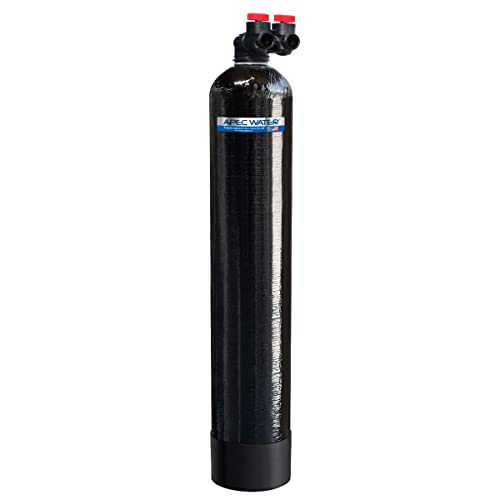
Salt-Free Conditioner
An alternative to traditional ion-exchange softening that alters mineral crystal structure to reduce scale formation without actually removing the minerals or adding sodium.
A salt-free conditioner does not soften water and the distinction is not pedantic. The common technology, template assisted crystallization, converts dissolved hardness minerals into microscopic crystals that will not adhere to pipe walls and heating elements. Scale is addressed. The minerals, however, are still dissolved in the water leaving the unit.
That means everything caused by the minerals themselves is unchanged: soap that will not lather, film on shower glass, spotting on dishes, and the characteristic feel of hard water on skin. If those are the symptoms bothering you, a conditioner will not fix them no matter how it is marketed. If your concern is scale in a water heater, it is a legitimate option that needs no salt and no drain.

Terms You Will Meet in a Quote or Spec Sheet
Service flow rate is the volume, in gallons per minute, that a unit can deliver while still softening properly. It is a separate specification from capacity and it is the one that governs whether your pressure holds up when several fixtures run at once. Related to it is pressure drop, the pressure the unit itself consumes. NSF/ANSI 44 requires that a certified softener not drop pressure by more than 15 psi at its rated service flow, which is a useful sanity check when a spec sheet is vague.
Salt efficiency is stated in grains of hardness removed per pound of salt, and it varies with the salt setting rather than being a fixed property of the machine. NSF/ANSI 44 includes a voluntary efficiency rating, and a unit only qualifies by meeting both salt and water efficiency targets at a stated setting, so an efficiency claim always belongs to a particular setting rather than the product in general. California sets its own floor of at least 4,000 grains per pound, which is why some listings quote that figure specifically.
Two more worth knowing. Bypass valve is the fitting that routes water around the softener, which you need for servicing and for filling a pool or watering a garden with untreated water. Bridging describes a crust of salt that forms across the brine tank leaving a void underneath, so the tank looks full while the unit has quietly stopped making brine. It is the single most common reason a working softener stops delivering soft water.
FAQ
What GPG level counts as ‘hard’ water?
Generally, 7-10.5 GPG is classified as hard, and above 10.5 GPG as very hard — check your specific water utility’s report or test your own water to find your exact level.
Is hardness the same as total dissolved solids?
No. Hardness measures calcium and magnesium specifically. Total dissolved solids counts everything dissolved in the water, including sodium, chloride and bicarbonate. A softener reduces hardness to near zero while leaving TDS broadly unchanged, because it swaps one dissolved ion for another rather than removing it.
What is the difference between a water softener and a water filter?
A filter physically removes particles or adsorbs contaminants, and it has a cartridge you replace. A softener exchanges ions and regenerates itself with salt. They solve different problems, and many homes with hard water and a taste or sediment concern end up running both in series rather than choosing between them.
Why do some listings say ‘grain capacity’ and others ‘grains per pound’?
Grain capacity is how much hardness the unit removes between regenerations, so it determines cycle frequency. Grains per pound is salt efficiency, so it determines running cost. A large-capacity unit run at a high salt setting can be less efficient per pound than a smaller one run economically.
GPG classification ranges can vary slightly between sources — use these as general reference points.
References
- Hardness of Water. U.S. Geological Survey
These statements have not been evaluated by the Food and Drug Administration. This information is not intended to diagnose, treat, cure, or prevent any disease. Content is for informational purposes only and is not medical advice; consult a qualified healthcare provider before starting any supplement. As an Amazon Associate we earn from qualifying purchases.
