Understanding the difference between consumer softener products and professional testing equipment clarifies what’s appropriate for home purchase.
Hardness is unusual among water quality parameters in that the consumer testing tools are genuinely good enough. For most contaminants there is a real gap between a home kit and a certified laboratory. For hardness, a titration kit costing a few dollars gives you a number accurate enough to size equipment and make a purchase decision, which is the whole reason you were testing.
- Consumer softener products are the appropriate purchase category for home treatment.
- Professional testing equipment beyond basic kits isn’t typically necessary given hardness testing’s relative simplicity.
- This distinction matters less for hardness than for hazards requiring specialized lab analysis.
- Basic DIY testing (strips, titration kits) is generally sufficient for home use.
Consumer Softener Products
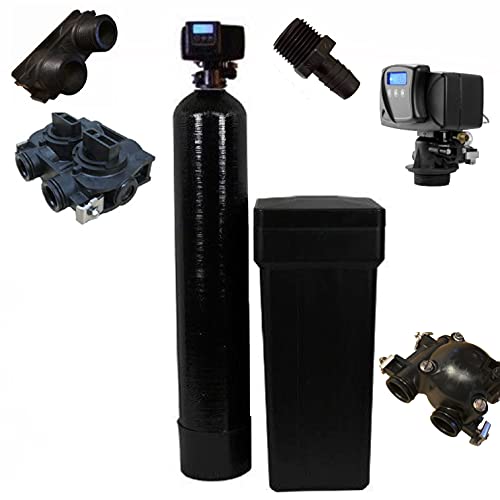
Consumer-grade water softeners (single-tank, dual-tank, salt-free conditioners) are designed and marketed for home installation — this is the appropriate purchase category.
Consumer softeners are not a lesser class of equipment. The same ion exchange process, resin chemistry and control valve designs appear in residential units across the price range, and NSF/ANSI 44 certification applies to consumer products just as it does to dealer-installed ones. What separates a good residential unit from a poor one is the control head and the sizing, not a professional tier that exists somewhere above it.
The difference that does exist is in support rather than hardware. A dealer relationship buys you sizing help, installation, startup and a service path. Buying the same class of unit online means you own all of that yourself. That is a real distinction and worth pricing honestly, but it is not a difference in what the machine can do.
Professional Testing Equipment
Precise titration equipment beyond basic DIY kits is used by water treatment professionals for detailed water quality analysis, not typically necessary for home purchase.
Laboratory instrumentation for water analysis exists for parameters where precision matters at very low concentrations, such as metals at parts per billion or organic compounds requiring chromatography. Hardness is not one of those. It is present at milligrams per liter, it is chemically simple, and a titration endpoint is unambiguous.
Where you should still use a certified laboratory is for anything with a health-based limit, particularly on a private well. Lead, nitrate, arsenic, coliform bacteria and similar parameters warrant accredited testing because the decision threshold is a safety threshold. Hardness carries no such threshold, which is exactly why the home kit suffices.
Why This Distinction Matters Less Here
Given hardness testing’s relative simplicity compared to health-based contaminants, this distinction matters less than for hazards requiring truly specialized lab analysis [1].
Sizing tolerance is the practical reason. Softener capacities come in standard steps, typically 24,000, 32,000, 48,000 and 64,000 grains, and you round up to the nearest one. A test that puts you within a grain per gallon of the truth lands you on the same capacity as a laboratory result would. Extra precision changes nothing you would do.
There is one place accuracy does matter, and it is the low end. Distinguishing genuinely soft water from slightly hard water decides whether you buy anything at all. If a strip reads near the bottom of its range, confirm with a drop kit or your utility’s report before concluding you have a problem worth spending on.

Choosing and Reading a Home Hardness Test
Test strips are the fastest option and the least precise. They rely on a color comparison against a printed chart, which is workable for a rough band but easy to misread in poor lighting or with an expired strip. They are best used as a screen that tells you whether a more careful measurement is worth doing.
Titration drop kits are the better tool and still inexpensive. You add reagent drop by drop to a measured water sample until the color changes, and the drop count converts directly to grains per gallon. The endpoint is a distinct change rather than a shade judgement, which is why the result is more reliable than a strip.
Sample from a cold tap that has run for a minute, so you are measuring the supply rather than water that has been standing in the line. If you already have a softener and want to check it is working, take one sample before the unit and one after. A large difference confirms the resin is still exchanging, and no difference points at a control valve or a bridged brine tank.
FAQ
Do I need professional-grade testing equipment for hardness?
Not typically — basic DIY testing (strips or titration kits) is generally sufficient given hardness testing’s relative simplicity compared to more complex contaminant analysis.
Do I need a lab test for hardness?
No. A home titration kit is accurate enough for every decision hardness feeds into. Reserve certified laboratory testing for health-based parameters, which on a private well means coliform bacteria and nitrate at minimum.
How much should I trust a free test from a softener dealer?
The chemistry is usually sound, since hardness is simple to measure. The interpretation is the part with a commercial interest attached. Take their number, then confirm it with your own kit before agreeing to anything.
Are commercial softeners better built than residential ones?
They are built for higher flow rates and continuous duty, which is a different requirement rather than a higher standard. Installing commercial equipment in a house generally means paying for capacity you cannot use and running it well below its design flow.
Basic DIY testing is generally sufficient here — professional lab analysis is more relevant for comprehensive water quality assessment than hardness alone.
References
- National Primary Drinking Water Regulations. U.S. Environmental Protection Agency
These statements have not been evaluated by the Food and Drug Administration. This information is not intended to diagnose, treat, cure, or prevent any disease. Content is for informational purposes only and is not medical advice; consult a qualified healthcare provider before starting any supplement. As an Amazon Associate we earn from qualifying purchases.
